
My Life Story-Part-7
Psychological Confinement Became One Of The Most Difficult Battles Of My Life, Silently Affecting My Identity, Confidence, And Emotional Well-Being.
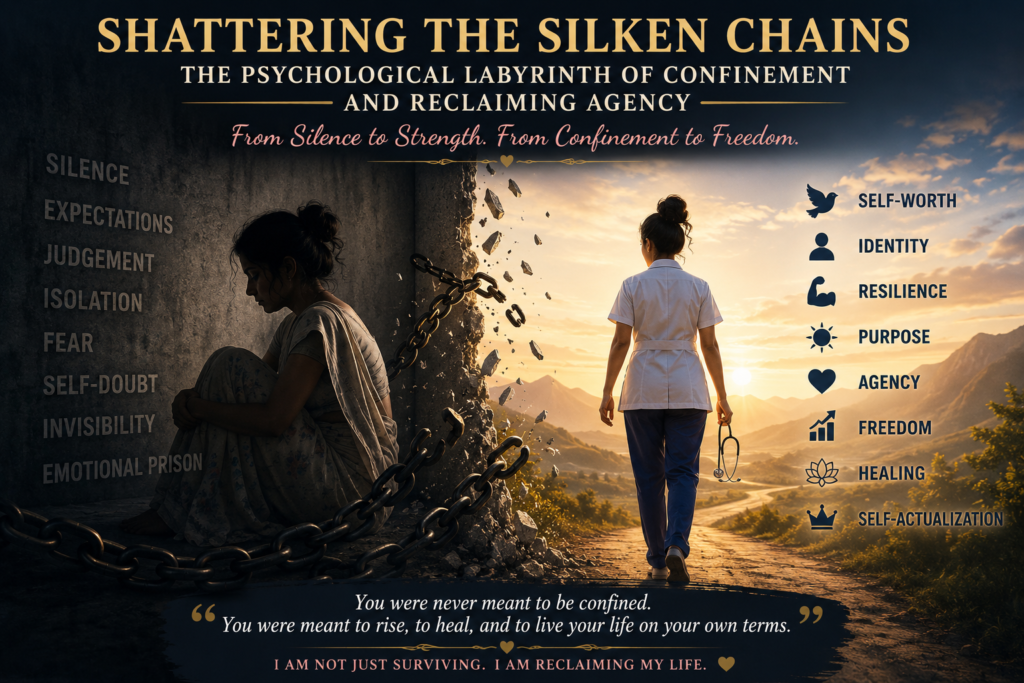
The Architecture Of Confinement : Understanding Psychological Imprisonment
To Understand How I Balanced Nursing, Motherhood, And Financial Survival, You Can Read My Previous Article, The Silent Warrior Returns: Balancing The White Coat And The Weight Of Motherhood.
In my antecedent publications, I delineated the palpable, materialistic manifestations of my isolation—the “Cattle Shed” wedding, the fiscal destitution, and the physical endurance demanded by pregnancy in absentia of a support network.
While those tangible adversities were formidable, they merely served as the visible scaffolding for a far more insidious and devastating construct: the profound Psychological Confinement that held my spirit in abeyance.
This confinement was not merely a matter of geographical boundary; it was a sophisticated mechanism of psychological control, an invisible architecture designed to subjugate my identity and enforce silence.
As a trained nursing professional, acutely aware of the Psychosocial Determinants of Health, I understood the clinical imperative for social integration and human connection.
Yet, I found myself navigating a reality where these fundamental human needs were deliberately withheld.
For trusted information about psychological well-being, resilience, and mental health, readers can visit the American Psychological Association (APA). Psychological Confinement taught me self-respect.
The prolonged isolation I endured was a potent catalyst for Chronic Psychological Stress, a state that systematically erodes Maternal Wellness and compromises Functional Resilience.
This sustained period of “waiting for acceptance” was not a passive act of patience; it was an active form of emotional labor, a continuous internal battle against the gradual dissolution of self-worth. In a society that emphasizes communal identity, enforced isolation is equivalent to psychological exile.
I was suspended in a liminal space, neither accepted nor rejected, existing in a state of perpetual ambiguity that is profoundly destabilizing to the human psyche.
The constant uncertainty became a form of psychological erosion, relentlessly wearing away at the core of my professional and personal identity. Psychological Confinement inspired personal growth.
The Cognitive Dissonance : The White Coat Versus The Silent Saree
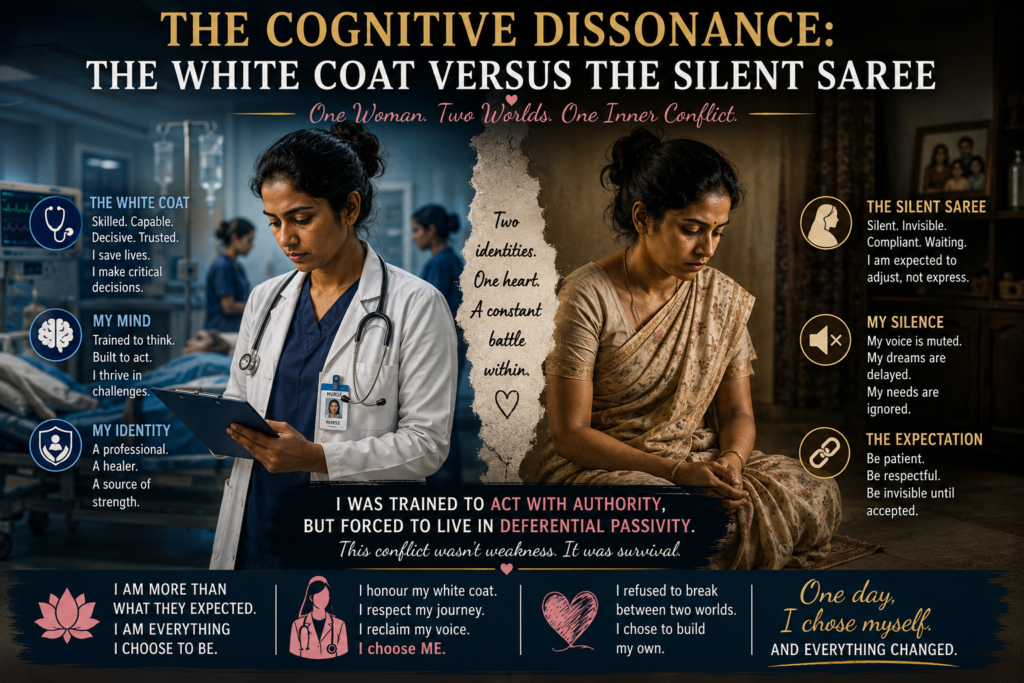
During this period of profound containment, I experienced an agonizing manifestation of Cognitive Dissonance. Psychological Confinement strengthened my inner voice.
This psychological state arises from the conflict between incompatible beliefs and actions, leading to significant emotional distress. On the one hand, I was a highly skilled medical professional, a recognized sister at a premier tertiary healthcare institution.
I possessed the acute clinical knowledge and decisiveness required to navigate life-or-death situations in the hospital. My professional identity was synonymous with agency, authority, and competence.
Psychological Confinement encouraged transformation.
Conversely, within the domestic sphere, I was expected to inhabit the role of a passive, silent, and compliant “new wife,” deferentially awaiting a family’s validation that seemed perpetually delayed. This discrepancy was not merely an inconvenience; it was a fundamental attack on my sense of self.
I was clinically trained to act with authority, yet socially coerced into submission. The nurse who managed complex medical crises was expected to become invisible when she stepped through the door of her home. Psychological Confinement changed my perspective on freedom.
This profound dissonance generated a pervasive sense of internal conflict and emotional fatigue. To maintain the facade of the compliant wife, I was forced to repress the very professional identity that was the source of my strength.
I had to silence the decisive voice that was critical on the medical ward, adopting a posture of deferential passivity that was completely antithetical to my nature.
This relentless suppression of my true self was a significant barrier to Overall Wellness, demonstrating that Functional Health Freedom is predicated on the integration of all aspects of one’s identity—professional, maternal, and personal. Psychological Confinement required courage to overcome.
The Catalyst For Liberation : Reclaming Personal Agency
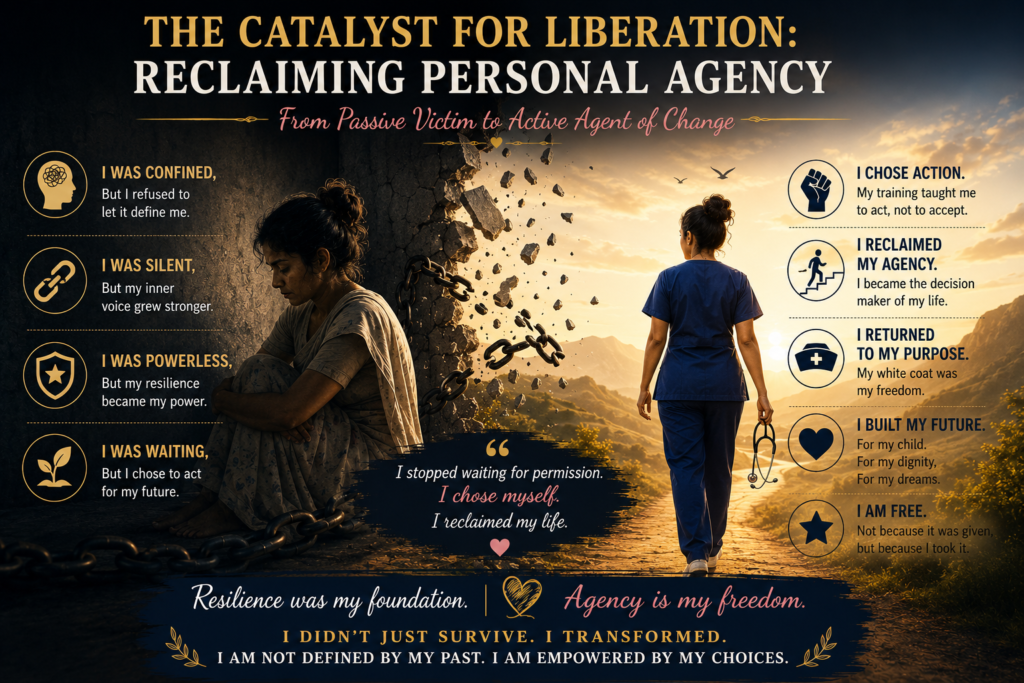
The transition from submission to agency did not occur through an external intervention or an act of benevolent acceptance; it was catalyzed by a profound shift in my own perception. While I was isolated and stripped of my financial resources and social capital, I discovered that I was not devoid of power.
Sustained adversity, rather than causing my spirit to fracture, had served as a crucible, refining my Intrinsic Resilience into an unbreakable foundation for action.
My training as a nurse, which emphasizes proactive intervention and clinical decisiveness, provided the precise intellectual framework needed to break the psychological impasse. In a clinical setting, when a patient’s condition is deteriorating, passive observation is not an option; immediate and decisive action is required to ensure survival.
I realized that my own Psychological Health was rapidly deteriorating, and that my family’s future was at stake. Applying this medical metaphor to my own life, I understood that I could no longer remain a passive observer of my own subjugation. Psychological Confinement taught me self-awareness.
This realization transformed my identity from a “passive victim” to an “active agent of change”. It was the shift from internal resilience to external agency—the conscious decision to translate my inner strength into concrete, external action.
My return to nursing was not merely a financial solution; it was a profound act of psychological reclamation. By stepping back into my white coat and reclaiming my professional authority, I was actively dismantling the invisible architecture of confinement that had held me for years.
I was asserting my right to be visible, audible, and functionally independent. This pivotal moment proved that genuine liberation is not granted by others; it is an act of sovereign self-assertion, the decisive step of reclaiming agency from the very circumstances designed to suppress it. Psychological Confinement challenged my emotional health.
Conclusion : Beyond Survival Toward Self-Actualization
This intricate chapter of my “Simple Health Journey” is about far more than physical endurance or financial strategy; it is a profound exploration of Psychological Vitality and the reclamation of holistic self-actualization.
I learned that true health is not just the absence of medical pathology; it is the capacity to integrate and honor all dimensions of one’s identity, refusing to succumb to external pressure that demands the suppression of your professional voice.
Psychological Confinement tested my resilience.
My journey through the psychological labyrinth of confinement taught me that sustained adversity does not inevitably lead to a fracturing of the spirit. Instead, it can serve as a catalyst for a profound deepening of one’s character, forging a resilience that is both indomitable and transformative.
Today, when I speak to patients as a Simple Health Coach, I do not merely discuss medical charts; I address the deep-seated impact that isolation, social determinants, and a lack of agency can have on overall health.
Psychological Confinement weakened my sense of identity.
I am no longer a silent nurse confined by an oppressive social expectation. I am a professional warrior, a mother, and a vocal advocate for holistic wellness.
If you are navigating your own complex psychological confinement—whether it is an oppressive relationship, a career that stifles your ambition, or societal expectations that demand your silence—know this: The catalyst for your liberation already resides within you.
It is your intrinsic resilience, the unbreakable core of your being that has endured every storm. Use it to shatter the silken chains that bind you, and embrace the profound, functional freedom to live your life on your own terms.
Psychological Confinement affected my confidence.
By Raji
“The strongest prison is the one built around your mind, and the greatest victory is learning how to break free.”